Laparoscopic skills trainer
Our five-person team developed a low-cost laparoscopic training box for a client working with surgeons in Uganda. The prototype used replaceable practice-task components and materials selected for availability. The final poster reports $23.68 in material cost, a 6 lb prototype, and a 33-second average reset time over twenty resets.
- Problem
- Surgeons in Uganda need an affordable, accessible way to practice for the KeyScope, an affordable laparoscope designed by our client. The box had to stay opaque, weigh under 10 lb, cost under $50 and use materials available there.
- My contribution
- This was team work across five of us. I presented the existing solutions and available research in our first oral presentation.
- Engineering decisions
- The team built with plywood, brackets, nails, dowels and clothespins, and the client confirmed those parts could be sourced or replaced. After client feedback, the team replaced the ligating-loop task with peg balance.
- Evidence
- Prototype photographs, a labeled task layout and the team's requirement-and-test table.
- Outcome
- The team reported $23.68 in material cost, 6.0 lb, a 33-second average reset over twenty resets and 0.85% light transmission.
- Scope
- $23.68 is the cost of prototype materials. Visibility was tested with an endoscope. Testing with the KeyScope and a study of training effectiveness were planned as future work.
- $23.68
- Prototype material cost, against a target under $50.
- 6.0 lb
- Prototype weight on a scale, against a target under 10 lb.
- 33 s
- Average reset time over twenty resets, against a target under 5 minutes.
How the box works
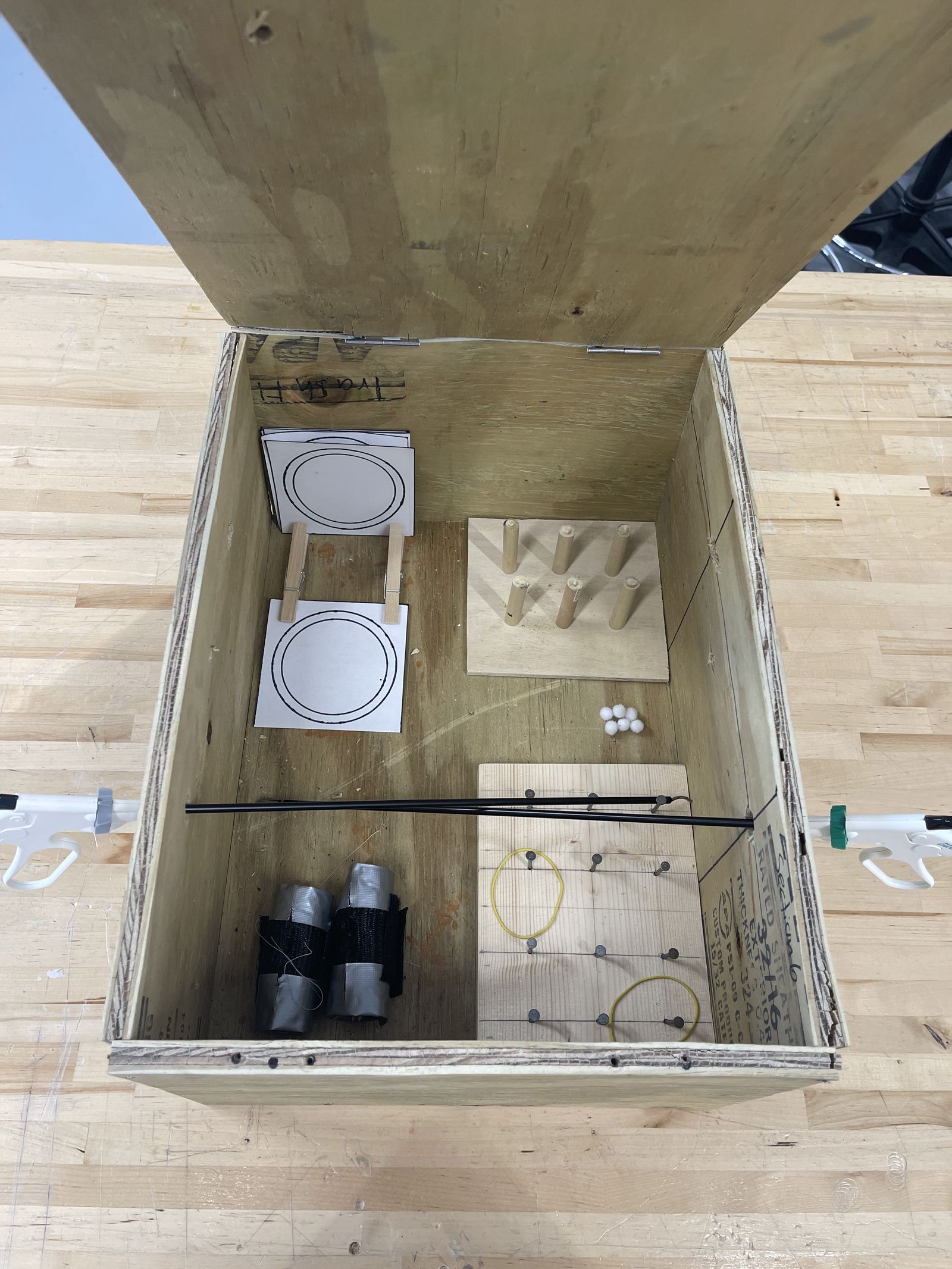
A trainee reaches into a closed plywood box with laparoscopic tools and sees the tasks through a scope. The tools enter through two holes in the sides. Four holes in the lid, one per task group, take the scope. The hinged lid opens for resetting.
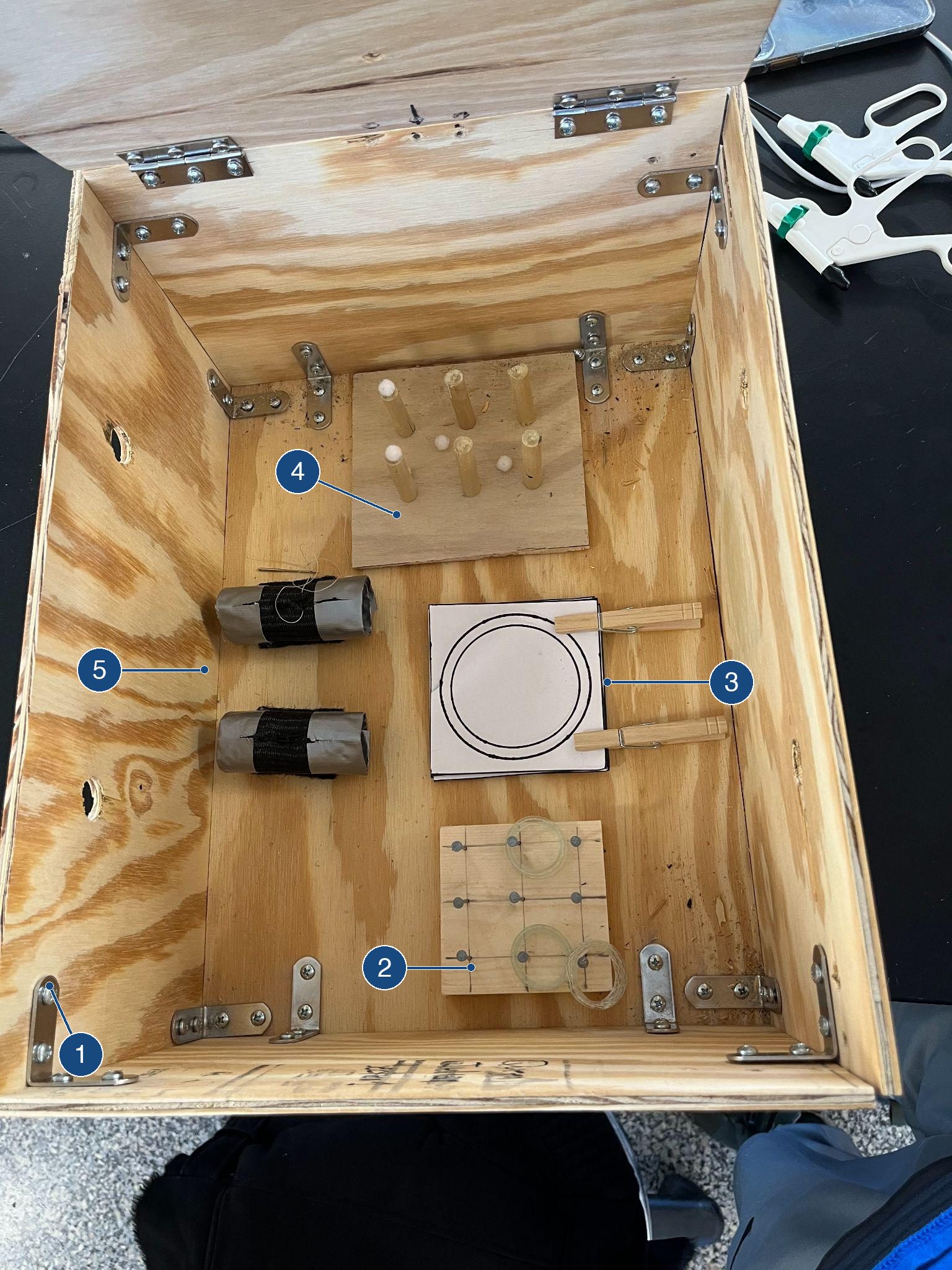
- 1: Box. ¼ in plywood with metal brackets and a hinged lid. Tools enter through holes in the sides.
- 2: Peg transfer. Nine nails as pegs, with three pieces of rubber tubing as rings.
- 3: Precision cutting. Paper with circles drawn on it, held by clothespins.
- 4: Peg balance. Wooden dowels on a plank, with cotton balls to balance on top.
- 5: Knot tying. Wire protector sealed with duct tape and attached with velcro and hot glue.
Design decisions
Materials chosen for availability. The testing plan treats training all five skills from the Fundamentals of Laparoscopic Surgery (FLS) exam, and opacity, as constraints, then ranks durability, cost, sourceability, reset time and weight. Commodity materials serve several of these at once. Paper targets and clipped parts are quick to replace, and the client reported that all materials were sourceable or easily replaced.
Replacing a task after client feedback. The first task set followed the five FLS skills, including a ligating loop. After client feedback, the team replaced the loop with peg balance. The result is a training box based on the FLS skills, not a certified FLS trainer, because one exam task is substituted.
Requirements and team test results
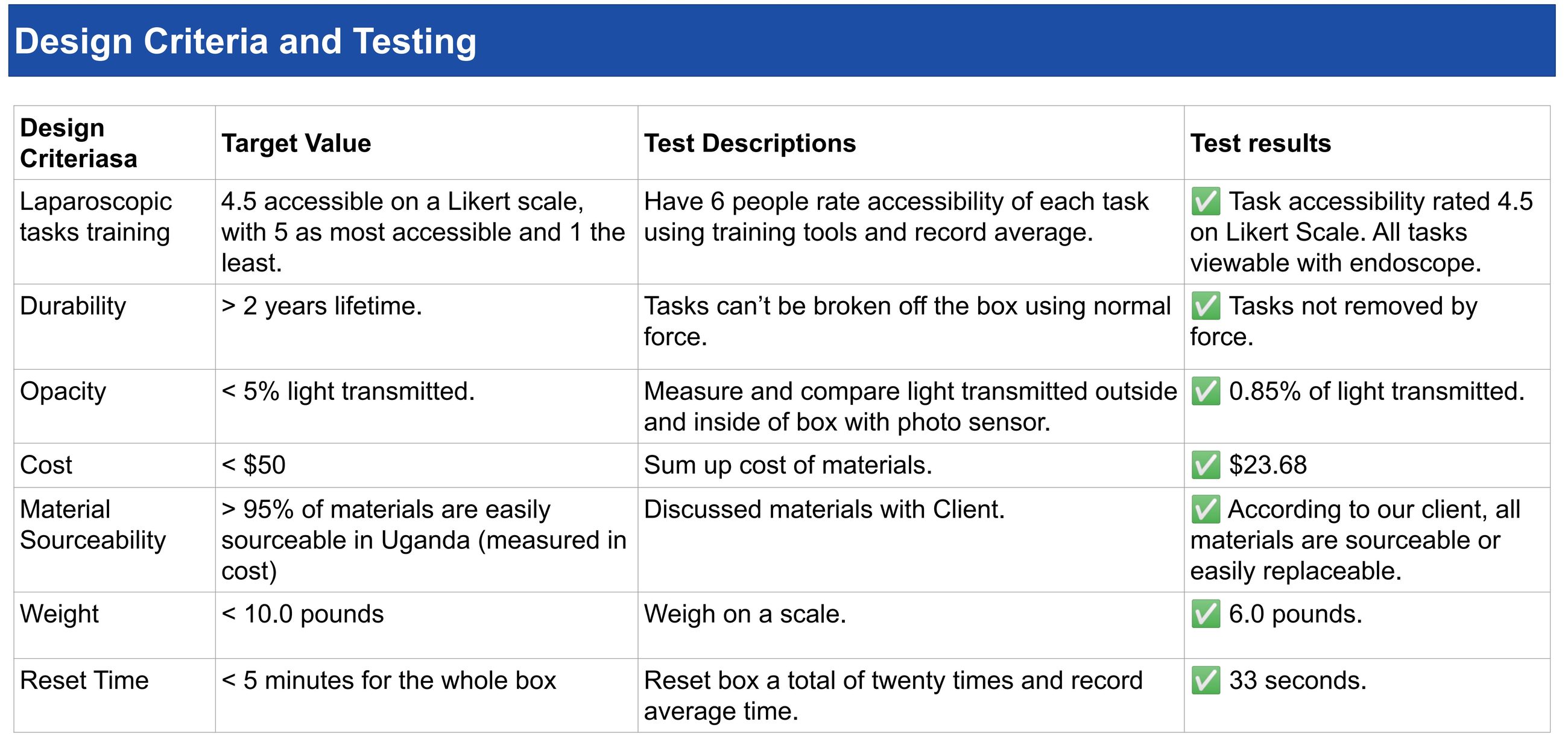
| Requirement | Target | Reported result | Method on the poster |
|---|---|---|---|
| Material cost | Under $50 | $23.68 | Sum of material costs |
| Weight | Under 10 lb | 6.0 lb | Weighed on a scale |
| Reset time | Under 5 min | 33 s average | Twenty resets of the box, timed |
| Opacity | Under 5% transmitted | 0.85% | Photosensor comparison of light outside and inside |
| Task accessibility | 4.5 of 5 | 4.5 of 5 | Average rating from six people; all tasks viewable with an endoscope |
Next steps
- Test the box with the KeyScope itself. Visibility has so far been tested with an endoscope.
- Run the planned three-week study of how well someone learns on the box, to measure training effectiveness.
- Check the two-year durability target. The test so far confirms that tasks can't be pulled off with normal force.
Team
This was a team of five.